
News
David Clark Company Has a New Home
David Clark is excited to share that our headquarters will be relocating to a new, modern facility designed specifically for the future of David Clark Company. This move from our present location, which we have occupied since 1963, will provide a more efficient layout, improved departmental collaboration, increased operational efficiency and enhanced environmental responsibility.
Moving over sixty years of history is no easy task, although our phased approach is designed to minimize interruption to ongoing operations. All normal points of contact will remain available via phone or email to assist with any questions or coordination needs during this transition.
Please note that our new address for U.S. Mail and all other packages is:
David Clark Company Inc.
125 Northeast Cutoff
Worcester, MA 01615-0054
While this milestone marks the end of an era at our current location, it signals the beginning of a more streamlined and sustainable chapter for David Clark Company. Although our address may be changing, the spirit of innovation and quality that we’ve built remains the foundation of everything we do. We are not just moving operations; we are carrying our legacy forward into a space that matches our excellence.

David Clark Company’s Model S1041 Orion Crew Survival System (OCSS) Suit Debuts on Historic Artemis II Lunar Flyby
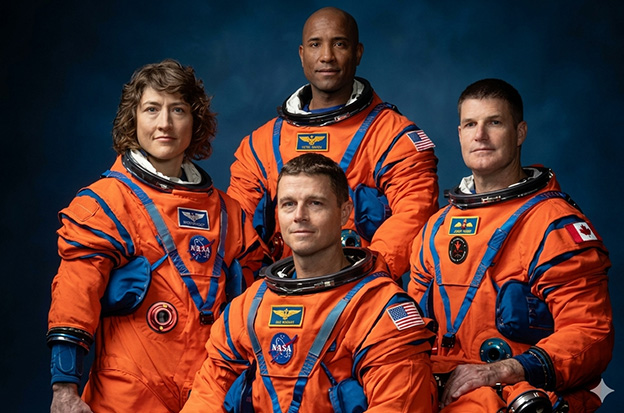
In April of 2026, the Artemis II mission returned humans to deep space for the first time in over 53 years. NASA astronauts Reid Wiseman, Victor Glover, and Christina Koch, along with Canadian Space Agency astronaut Jeremy Hansen, wore David Clark Company’s Model S1041 Orion Crew Survival System, for launch on April 1st, and re-entry on April 10th. The crew also performed an in-flight test of the suits on April 5th, during their historic mission around the Moon.
The Model S1041 OCSS is David Clark Company’s newest spacesuit, and by far the most capable launch/entry spacesuit ever flown. In addition to providing the crew protection from a variety of contingencies and hazards during dynamic phases of flight, the OCSS suit also serves as a backup safe-haven/secondary pressurizable environment, which the crew would use in the event of a deep-space cabin depressurization.
The OCSS has been specifically designed for the Orion spacecraft and for the Artemis program. Each OCSS suit was custom built to each crewmember’s unique anthropometry, and is capable of contingency 8 psid pressurized operations. The suit has been designed and qualified for a pressurized contingency scenario lasting up to 6 days.
The Artemis II mission was extremely successful and no such contingencies occurred. As this was the first crewed test-flight of the Artemis program, the crewmembers tested the suits in microgravity, performing rapid donning evaluations and pressurizing the suits, to evaluate their custom fit and suit performance in such a depressurized cabin scenario.
Other functionalities built into the Model S1041 OCSS suit include highly mobile shoulders and elbows, touch-screen gloves, footwear with embedded flail restraint features that mate to the seat, and an integral extraction harness. The suit includes flotation devices and a deployable neck seal for contingency water operations. Integral oxygen bottles provide short-duration on-suit life support, in the event of an emergency pad egress. Two sizes of helmet and a unique helmet support assembly work in concert with the seat restraints to provide head protection and ensure the crew are properly restrained during dynamic loading scenarios.
The Artemis II mission concluded on April 10, splashing down in the Pacific Ocean and safely returning the crew to Earth. With this successful completion of Artemis II, DCCI is now focused on developing and manufacturing the OCSS suits for Artemis III – a Low Earth Orbit test flight – and the suits for Artemis IV and V, missions that will return humans to the Lunar surface. Additionally, DCCI is working with Axiom Space on the suit that crewmembers will wear to perform spacewalks on the Moon.
David Clark Company’s Newest Space Suit
Flown on Historic Crew Flight Test
On June 5, 2024, NASA astronauts Butch Wilmore and Suni Williams wore David Clark Company’s newest space suit, the S1100 Salus, to orbit. Launched aboard Boeing’s Starliner spacecraft at 10:52am EDT, as part of Crew Flight Test, the two crewmembers wore their Salus suits throughout launch operations, beginning their journey to the International Space Station. They will wear the suits for docking and reentry operations, as they complete this certification flight of the vehicle and the suit.
The S1100 Salus is the lightest weight space suit ever flown. It is extremely comfortable, minimal thermal burden, and does not require the complexity, mass and bulk associate to liquid cooling. Its integral air-cooling features, including a diverter valve that allows for multiple operating modes, and a selectively permeable bladder layer, kept the crewmembers cool as they waited on the launch pad prior to launch from the Florida coast.
Building upon David Clark’s storied history as a provider of space suits for Gemini, Apollo and Space Shuttle missions, the engineering and design team incorporated innovative features in the new suit design, such as touch-screen compatible gloves, a soft helmet, and lightweight conformal footwear – co-developed with Reebok. The extremely wide field of view, high mobility elbows and shoulders, and minimal bulk ensure crewmembers have maximum capability inside their spacecraft, for both nominal and contingency operations.
With the successful completion of Crew Flight Test, this suit will serve as the qualified baseline design for Starliner. Additionally, the S1100 Salus is the new gold standard for launch and entry space suits, serving as a design reference for future David Clark suit designs.